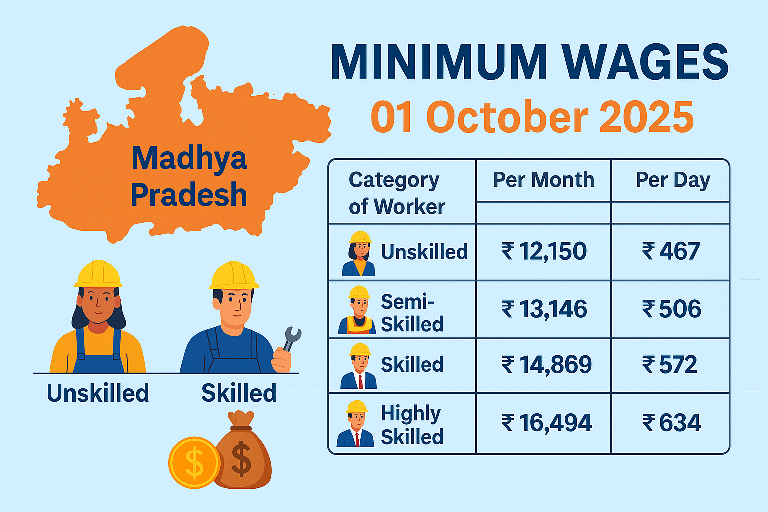
The Government of Madhya Pradesh has released a notification on 01 October 2025 revising the Minimum Wages & Variable Dearness Allowance (VDA) for employees working in 67 scheduled employments under the Minimum Wages Act, 1948.
This revision is effective from 01 October 2025 to 31 March 2026. The change is due to a 1-point increase in the All India Consumer Price Index (AICPI), resulting in a ₹25/- monthly hike in VDA across all worker categories.
🔹 Applicability 🏢
✔️ Covers 67 Scheduled Employments in Madhya Pradesh ✔️ Applies to Unskilled, Semi-Skilled, Skilled & Highly Skilled workers ✔️ Enforceable under the Minimum Wages Act, 1948 ✔️ Employers must ensure no worker is paid below these rates
📊 Revised Minimum Wages in Madhya Pradesh (01 Oct 2025 – 31 Mar 2026)
🧑🏭 Worker Category
📑 Basic Wages (₹/Month)
📑 Basic (₹/Day)
💸 VDA (₹/Month)
💸 VDA (₹/Day)
💰 Total Wages (₹/Month)
💰 Total (₹/Day)
✅ Rounded Daily Rate
👷 Unskilled
9,575
368.27
2,575
99.04
12,150
467.31
₹467
👷♂️ Semi-Skilled
10,571
406.58
2,575
99.04
13,146
505.62
₹506
🏗️ Skilled
12,294
472.85
2,575
99.04
14,869
571.89
₹572
🛠️ Highly Skilled
13,919
535.35
2,575
99.04
16,494
634.39
₹634
🔹 Key Highlights 📌
✨ Uniform VDA Increase – ₹25/- added to all worker categories ✨ Unskilled Workers – ₹12,150/month or ₹467/day ✨ Highly Skilled Workers – ₹16,494/month or ₹634/day ✨ Strict Enforcement – Any payment below these wages = violation of Minimum Wages Act, 1948 🚨
🔹 Compliance Advice for Employers 🏭
⚡ Update payroll systems from October 2025 onward ⚡ Revise wage registers, payslips & statutory filings ⚡ Communicate changes to contractors/vendors to avoid gaps ⚡ Maintain compliance to prevent penalties & inspections
✅ Conclusion 🎯
The Madhya Pradesh Government’s October 2025 wage revision brings only a nominal hike of ₹25/- in VDA, but ensures inflation-linked protection for workers. Employers must strictly implement revised wages for Oct 2025 – Mar 2026 to stay compliant.
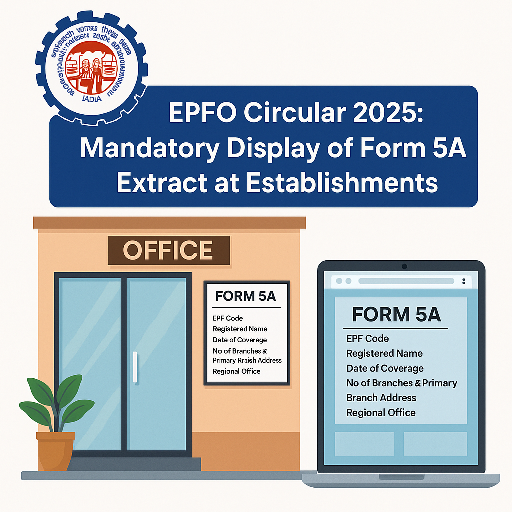
The Employees’ Provident Fund Organisation (EPFO) has issued a new compliance directive dated 6th October 2025 under the Employees’ Provident Funds Scheme, 1952. As per this notification, all employers covered under the EPF Act must ensure prominent display of the extract of Form 5A at their establishments. This move is aimed at enhancing transparency, accountability, and employee awareness.
This update is highly relevant for HR managers, compliance officers, and business owners looking for latest EPFO compliance requirements 2025.
🔑 What is Form 5A in EPFO?
Form 5A is an Employer’s Registration Form under the EPF Act. It captures essential details about an establishment, including:
Establishment’s EPF Code Number
Registered Name of the Employer
Date of Coverage under the EPF Act
Primary and branch office addresses
Regional PF Office jurisdiction
The Form 5A extract serves as a ready reference for both employees and EPFO inspectors during compliance verification.
📜 Key Highlights of the Circular
1. Where to Display?
Employers must prominently display the extract of Form 5A:
At the entrance of the establishment, OR
On the official website and mobile application of the establishment.
2. Mandatory Details to Include
The following fields must be visible: 1️⃣ EPF Code 2️⃣ Registered Name 3️⃣ Date of Coverage 4️⃣ Number of Branches & Primary Branch Address 5️⃣ Regional Office
3. Deadline for Compliance
Employers are required to complete this compliance within 15 days of the order, i.e., by 21st October 2025.
4. Penalties for Non-Compliance
Failure to comply may attract legal action under the Employees’ Provident Funds & Miscellaneous Provisions Act, 1952. Employers may face penalties, inspections, or prosecution for violation of statutory duties.
⚖️ Why This Matters for Employers
This directive will now form a standard inspection checkpoint for EPFO field officers. By making Form 5A details public, establishments can:
Build employee trust and awareness of EPF coverage
Avoid inspection-related disputes
Ensure seamless compliance during audits
Strengthen their reputation as a statutory compliant organisation
📌 Action Plan for Employers
To ensure compliance with the EPFO’s 2025 directive:
Prepare a Display Board – Place it at the entrance of the main office/factory.
Update Digital Platforms – Upload Form 5A details on your website and mobile app.
Keep Compliance Evidence – Maintain photos of display boards and screenshots of website uploads.
Train HR/Compliance Teams – Ensure timely updates during future inspections.
Conclusion
The new EPFO directive on Form 5A is a significant step towards improving workplace compliance and transparency. Employers must act quickly to avoid penalties and demonstrate their commitment to statutory compliance under the EPF Act.
📅 Remember the deadline: 21st October 2025. Ensure your establishment is ready for inspection with a Form 5A display board and digital presence today.
Delhi Minimum Wages (October 2025 – March 2026): Latest Update
Keeping track of Delhi Minimum Wages is critical for employers, HR professionals, contractors, and workers. The Government of India, through the Office of the Chief Labour Commissioner (Central), has revised the Variable Dearness Allowance (VDA) linked to the Consumer Price Index – Industrial Workers (CPI-IW). The revised rates are effective from 1st October 2025 to 31st March 2026.
🔑 Key Highlights
Effective Period: 01 October 2025 – 31 March 2026
Applicable To: Agriculture, Construction, Mines, Sweeping & Cleaning, Watch & Ward, Loading & Unloading, and Stone Mines.
CPI-IW Base: 2016 = 100; Average = 413.42 (increase of 11.33 points)
Area Classification: Area A, B, and C (as per 19 January 2017 notification)
Compliance Requirement: Contractors and employers must update wage structures accordingly.
📊 Delhi Minimum Wages 2025-26 (Per Day)
1. Agriculture Sector
Category
Area A
Area B
Area C
Unskilled
₹514
₹470
₹465
Semi-Skilled / Unskilled Supervisory
₹562
₹516
₹475
Skilled / Clerical
₹610
₹562
₹515
Highly Skilled
₹675
₹628
₹562
2. Construction / Building Operations
Category
Area A
Area B
Area C
Unskilled
₹805
₹674
₹541
Semi-Skilled / Unskilled Supervisory
₹893
₹760
₹632
Skilled / Clerical
₹981
₹893
₹760
Highly Skilled
₹1,065
₹981
₹893
3. Sweeping & Cleaning
Category
Area A
Area B
Area C
All Workers
₹805
₹674
₹541
4. Watch & Ward
Without Arms: A – ₹981, B – ₹893, C – ₹760
With Arms: A – ₹1,065, B – ₹981, C – ₹893
5. Mines
Category
Above Ground
Below Ground
Unskilled
₹541
₹674
Semi-Skilled
₹674
₹805
Skilled
₹805
₹938
Highly Skilled
₹938
₹1,049
6. Stone Mines (Piece Rate Examples)
Soft Soil Excavation: ₹545
Rock Excavation: ₹1,083
Breaking/Crushing (per 2.832 m³): ₹1,372 – ₹3,323
📌 Why This Matters for Employers
Statutory Compliance – Paying below notified minimum wages attracts penalties under the Minimum Wages Act, 1948.
Payroll Adjustments – HR teams must update salary registers, wage slips, and ECR filings.
Contractor Management – Principal employers must ensure contractors implement revised wages in bills.
Audit Preparedness – Proper records help during Labour Department inspections and PF/ESIC audits.
✅ Conclusion
The Delhi Minimum Wages (Oct 2025 – Mar 2026) notification ensures fair wages for workers across multiple sectors. Employers and contractors must act immediately to incorporate these changes into their payroll systems, contracts, and compliance documents. Staying updated with these changes helps avoid penalties and ensures smooth statutory compliance.
📢 Stay tuned to PCS Blog for the latest labour law updates, compliance tips, and minimum wage notifications across India.
The Maharashtra Government has introduced the Maharashtra Shops & Establishments (Amendment) Ordinance, 2025, effective 1st October 2025. This update to the Maharashtra Shops & Establishments Act, 2017 is one of the most important labour law updates in India 2025.
The amendment focuses on:
📉 Reducing compliance burden for small businesses,
📈 Ease of Doing Business in Maharashtra,
⏰ Flexibility in daily working hours, and
💰 Stronger overtime rules for employees.
For every shop, restaurant, retail outlet, and office in Maharashtra, this is a critical statutory compliance update.
🔑 Key Amendments under Maharashtra Shops Act 2025
Provision
Old Rule (Before 2025 Amendment)
New Rule (2025 Amendment)
Registration Threshold
Registration required for 10 or more employees
Registration mandatory only for 20 or more employees. Shops & establishments with less than 20 only need business intimation
Daily Working Hours
Maximum 9 hours per day
Increased to 10 hours per day, subject to 48 hours per week
Weekly Hours
Capped at 48 hours per week
No change – remains 48 hours per week
Spread-Over of Work
10.5 hours maximum per day
Extended to 12 hours per day
Continuous Work without Break
5 hours continuous work allowed
Increased to 6 hours continuous work before rest interval
Overtime Limit
Maximum 125 hours per quarter
Raised to 144 hours per quarter with double wages
Women Employees (Night Shift)
Permitted with safety & transport
No change – safety, security, and transport remain mandatory
🎯 Why the Amendment Matters
The Maharashtra Shops & Establishments Amendment 2025 is designed to reduce compliance hurdles and improve labour law compliance in Maharashtra.
Key objectives:
📉 Reduce compliance for shops with less than 20 employees.
📈 Provide operational flexibility with 10-hour daily limit and 12-hour spread-over.
💰 Protect workers with formal overtime up to 144 hours per quarter.
🚀 Strengthen Ease of Doing Business reforms Maharashtra 2025.
👉 Trending search keywords: Maharashtra labour law amendment 2025, Shops & Establishments Act changes, daily working hours labour law Maharashtra, overtime rules Maharashtra 2025.
📋 Employer Compliance Checklist 2025
Compliance Area
What Employers Must Do
Employee Count & Registration
Registration mandatory if 20 or more employees. If less than 20, provide only business intimation.
Working Hours
Ensure no employee works beyond 10 hours daily or 48 hours weekly.
Spread-Over
Daily spread-over not to exceed 12 hours.
Rest Intervals
Provide a break after 6 hours continuous work.
Overtime Rules
Overtime ceiling is 144 hours per quarter, with double wages paid.
Registers & Records
Maintain statutory registers for attendance, wages, overtime, and leave.
Women Night Shift Rules
Provide safe transport, security, and Labour Dept. intimation.
Wages & Payments
Ensure compliance with minimum wages Maharashtra 2025 and issue payslips.
Display & Notices
Display updated labour law notices on working hours and weekly offs.
⚠️ Key Challenges for Employers
Implementing 10-hour workdays without breaching weekly limits.
Updating policies for women employees in night shifts.
Maintaining error-free wage registers and overtime records for inspections.
📈 Impact on Businesses & Employees
🏪 Retail Shops & Malls: Flexibility for extended working hours and 24×7 operations.
🍴 Restaurants & Hospitality: Better capacity to manage late-night demand.
👩💼 Employees: More opportunities for legal overtime earnings.
📉 Small Businesses: Reduced paperwork as registration threshold increases from 10 to 20 employees.
📌 Conclusion
The Maharashtra Shops & Establishments Amendment Ordinance, 2025 is a game-changer in labour law reforms. It balances the needs of Ease of Doing Business with the protection of workers’ rights.
✅ Employers must:
Update shift rosters for 10 hours daily and 12 hours spread-over,
Track overtime up to 144 hours per quarter,
Verify staff strength for registration compliance (20+ employees), and
Maintain complete labour law records.
📢 Final Word: This labour law update Maharashtra 2025 is a progressive step. Employers should act now to update compliance systems and HR policies to stay legally secure.
In a significant move, the Government of Maharashtra has clarified that shops and restaurants can now remain open 24 hours a day, 7 days a week under the Maharashtra Shops and Establishments (Regulation of Employment and Conditions of Service) Act, 2017.
This update brings Mumbai and other major cities in Maharashtra in line with the global trend of building a “night economy”, encouraging employment opportunities, boosting tourism, and offering more convenience to consumers. However, for employers, this also means stricter compliance obligations under labour laws.
🔑 Key Highlights of the Government Clarification
✅ 24×7 Operations Permitted: Shops and restaurants can function without restrictions on timing.
❌ Exception: Only outlets serving liquor remain excluded.
✅ Business Advantage: Retailers, hoteliers, and restaurants gain operational flexibility, creating scope for higher revenues and more employment.
✅ Industry Welcome: Associations such as the Retailers Association of India and the Federation of Hotel & Restaurant Associations of India have welcomed this clarification.
⚖️ Employer Compliance Obligations under the 2017 Act
While the permission for 24×7 shops in Maharashtra is progressive, businesses must ensure strict adherence to compliance norms:
1. Duty Hours & Weekly Offs
Employees must not be made to work beyond prescribed duty hours.
Weekly holidays are mandatory, and overtime must be paid as per law.
2. Wages & Record Maintenance
Timely payment of wages as per the Payment of Wages Act.
Proper registers for attendance, overtime, salary, and leave must be maintained and produced during inspections.
3. Women Employees & Night Shifts
Safety and transport arrangements must be ensured for women working at night.
Prior intimation and approval may be required from the Labour Department or DISH when employing women beyond permissible hours.
4. Health & Safety Measures
Fire safety, first aid, and sanitation facilities must be in place.
Coordination with civic authorities is critical for garbage disposal, late-night cleanliness, and emergency management.
⚠️ Practical Challenges Ahead
Even though the law permits round-the-clock functioning, practical challenges continue:
Police authorities may still insist on early closure citing law-and-order concerns 🚔.
Civic challenges such as waste management 🚮 and fire safety 🔥 need strict monitoring.
Ensuring safe transportation and security for employees, particularly women 🛡️, is a statutory responsibility.
📈 Impact on Businesses & the Economy
🏪 Retail Sector: Extended operations may attract more footfall and improve sales.
🍴 Hospitality Industry: Restaurants, cafés, and eateries will benefit from late-night demand.
👩💼 Employment: More job opportunities for staff across shifts.
✈️ Tourism Boost: Strengthens Maharashtra’s image as a global business and leisure hub.
📌 Conclusion
The Maharashtra 24×7 shops and restaurants law is a landmark reform that promotes business growth while aligning with global practices. However, compliance obligations under the Maharashtra Shops and Establishments Act, 2017 remain crucial.
Employers must ensure that employee welfare, labour law compliance, and safety measures are not compromised while leveraging this opportunity.
🔎 For businesses in retail and hospitality, this is the right time to revisit internal shift policies, safety measures, and statutory registers to stay fully compliant while enjoying the benefits of round-the-clock operations.
The Government of Bihar has officially revised the minimum wages for all scheduled employments with effect from 1st October 2025. This revision has been notified under Section 3 & 5 of the Minimum Wages Act, 1948, and is based on the Special Allowance (VDA) linked to the Consumer Price Index (CPI).
This change impacts employers across manufacturing, factories, shops, commercial establishments, and other scheduled employments in Bihar. Employers must update their payroll systems to comply with the revised wage rates to avoid penalties and ensure statutory compliance.
📊 Bihar Minimum Wages Rates (w.e.f. 01.10.2025)
Category of Worker
Daily VDA (₹)
Old Wages (₹/Day)
New Wages (₹/Day)
Approx. Monthly Wages (₹)*
Unskilled
4
424
428
11,128
Semi-Skilled
4
440
444
11,544
Skilled
5
536
541
14,066
Highly Skilled
6
654
660
17,160
*Calculated on 26 working days/month (as generally considered for minimum wage calculations).
✅ Key Highlights
Effective Date: 1st October 2025
Applicable To: All scheduled employments in Bihar
Basis of Revision: Variable Dearness Allowance (VDA) linked to CPI
Impact: Increase in daily wages ranging from ₹4 to ₹6 per day
Compliance: Employers must update wage registers, payroll, and salary slips as per revised rates
🔍 Why This Matters for Employers
Statutory Compliance: Non-adherence can lead to penalties, interest, and legal action under the Minimum Wages Act, 1948.
Payroll Adjustments: HR and payroll teams must revise Basic Wages + VDA in salary structures.
Bonus & Gratuity Impact: Since these benefits are linked to minimum wages, the revised rates will influence annual bonus calculations and gratuity liabilities.
Contract Labour: Contractors engaged in Bihar must ensure that revised rates are implemented for all workers.
📌 Conclusion
The Bihar Minimum Wages (Oct 2025 – March 2026) revision ensures workers’ wages are aligned with inflationary trends. Employers are advised to implement these changes immediately and maintain compliance.
For businesses operating in Bihar, it is crucial to update wage records, issue revised appointment letters (if necessary), and train payroll teams on the updated structure.
📢 Stay tuned with Prakash Consultancy Services (PCS) for timely updates on Minimum Wages Notifications, Labour Laws, EPF, ESIC, PT, and LWF across India.
The Central Government has revised the minimum wages applicable to employments under its purview, effective from 1st October 2025 to 31st March 2026. This revision, notified by the Office of the Chief Labour Commissioner (Central), covers scheduled employments such as construction, mines, oilfields, railways, and central public sector establishments, and acts as a benchmark for several states as well.
This article explains the latest updates, effects, and compliance requirements in detail for employers and employees.
📌 Key Highlights of the Wage Revision
Effective Period: 1st October 2025 – 31st March 2026
Frequency of Revision: Twice a year (April & October), linked to the Consumer Price Index (CPI-IW)
✅ Benefits & Positive Impacts
Improved Worker Welfare Workers in the lowest income bracket will see higher take-home pay, improving living standards and reducing dependency on debt.
Reduction in Wage Inequality By raising the floor wage, the gap between low-wage and mid-wage earners reduces, thereby helping income equity.
Boost in Consumption Demand Since low-wage workers spend a larger share of their earnings, higher wages will stimulate local markets.
Social Security Contributions With higher wages, contributions under EPF, ESIC, Bonus, and Gratuity also increase, ensuring better long-term security.
⚠️ Challenges for Employers
Higher Compliance Costs Employers will need to adjust payroll, leading to higher wage bills and associated statutory contributions.
Risk of Informalisation Some establishments may try to bypass compliance by pushing workers into informal arrangements.
Inflationary Pressure Rising labour costs could translate into price hikes in certain labour-intensive industries.
Enforcement Gaps Non-compliance is a risk, especially in small contractors and subcontracted employments.
📌 Compliance Checklist for Employers
Revise wage structures in line with the notified minimum wages.
Update payroll systems to reflect changes in Basic + VDA.
Ensure statutory contributions (PF, ESIC, Bonus, LWF, PT, Gratuity) are recalculated on revised wages.
Communicate the changes transparently to employees.
Maintain updated wage registers and muster rolls for inspection.
🔎 Broader Implications (Oct 2025 – Mar 2026)
For Workers: Direct rise in wages and social security benefits.
For Employers: Higher labour costs but potential productivity gains if managed efficiently.
For Economy: Positive impact on aggregate demand, but watch for inflationary pressures.
For Compliance Professionals: Increased demand for accurate payroll & statutory management.
🏁 Conclusion
The Central Government’s minimum wage revision (Oct 2025 – Mar 2026) reinforces the importance of fair wages, worker welfare, and statutory compliance. While it brings undeniable benefits to workers, it also challenges employers to restructure costs and maintain compliance discipline.
Employers are advised to review wage structures, consult compliance experts, and adopt transparent practices to ensure smooth implementation. Workers, on the other hand, should remain informed of their rights to fair wages and timely social s
The Central Government has revised the minimum wages applicable to employments under its purview, effective from 1st October 2025 to 31st March 2026. This revision, notified by the Office of the Chief Labour Commissioner (Central), covers scheduled employments such as construction, mines, oilfields, railways, and central public sector establishments, and acts as a benchmark for several states as well.
This article explains the latest updates, effects, and compliance requirements in detail for employers and employees.
📌 Key Highlights of the Wage Revision
Effective Period: 1st October 2025 – 31st March 2026
Frequency of Revision: Twice a year (April & October), linked to the Consumer Price Index (CPI-IW)
✅ Benefits & Positive Impacts
Improved Worker Welfare Workers in the lowest income bracket will see higher take-home pay, improving living standards and reducing dependency on debt.
Reduction in Wage Inequality By raising the floor wage, the gap between low-wage and mid-wage earners reduces, thereby helping income equity.
Boost in Consumption Demand Since low-wage workers spend a larger share of their earnings, higher wages will stimulate local markets.
Social Security Contributions With higher wages, contributions under EPF, ESIC, Bonus, and Gratuity also increase, ensuring better long-term security.
⚠️ Challenges for Employers
Higher Compliance Costs Employers will need to adjust payroll, leading to higher wage bills and associated statutory contributions.
Risk of Informalisation Some establishments may try to bypass compliance by pushing workers into informal arrangements.
Inflationary Pressure Rising labour costs could translate into price hikes in certain labour-intensive industries.
Enforcement Gaps Non-compliance is a risk, especially in small contractors and subcontracted employments.
📌 Compliance Checklist for Employers
Revise wage structures in line with the notified minimum wages.
Update payroll systems to reflect changes in Basic + VDA.
Ensure statutory contributions (PF, ESIC, Bonus, LWF, PT, Gratuity) are recalculated on revised wages.
Communicate the changes transparently to employees.
Maintain updated wage registers and muster rolls for inspection.
🔎 Broader Implications (Oct 2025 – Mar 2026)
For Workers: Direct rise in wages and social security benefits.
For Employers: Higher labour costs but potential productivity gains if managed efficiently.
For Economy: Positive impact on aggregate demand, but watch for inflationary pressures.
For Compliance Professionals: Increased demand for accurate payroll & statutory management.
🏁 Conclusion
The Central Government’s minimum wage revision (Oct 2025 – Mar 2026) reinforces the importance of fair wages, worker welfare, and statutory compliance. While it brings undeniable benefits to workers, it also challenges employers to restructure costs and maintain compliance discipline.
Employers are advised to review wage structures, consult compliance experts, and adopt transparent practices to ensure smooth implementation. Workers, on the other hand, should remain informed of their rights to fair wages and timely social security benefits
The Labour & Employment Department, Government of Gujarat has released the revised minimum wages notification effective from 1st October 2025 to 31st March 2026. This update is crucial for HR managers, payroll teams, compliance officers, contractors, and principal employers across the state, as it determines the statutory floor wages payable to employees engaged in all 46 scheduled employments.
📢 Key Highlight: Special Allowance (VDA) Revision
The Government has revised the Variable Dearness Allowance (VDA) based on the Consumer Price Index (CPI – Ahmedabad Centre).
Effective Date: 01 October 2025
Validity: Up to 31 March 2026
Revised VDA: ₹48.50 per day (Uniform for Zone I & II)
Monthly Equivalent: ₹1,261 (for 26 working days)
📊 Minimum Wages in Gujarat (Oct 2025 – Mar 2026)
Below is the category-wise and zone-wise structure combining Basic Wages + VDA (newly revised):
Category
Zone I (Per Day)
Zone II (Per Day)
Monthly Equivalent (26 days)
Unskilled
₹452 + ₹48.50 = ₹500.50
₹441 + ₹48.50 = ₹489.50
₹13,013 – ₹12,727
Semi-Skilled
₹462 + ₹48.50 = ₹510.50
₹451 + ₹48.50 = ₹499.50
₹13,273 – ₹12,987
Skilled
₹472 + ₹48.50 = ₹520.50
₹461 + ₹48.50 = ₹509.50
₹13,533 – ₹13,247
👉 These wage rates are applicable to all scheduled employments notified under the Gujarat Minimum Wages Act.
⚖️ Legal Backing
This notification has been issued under the provisions of the Minimum Wages Act, 1948 (till fully replaced by the Code on Wages, 2019).
Binding Nature: Employers cannot pay less than the prescribed minimum wage.
Penalty for Non-Compliance: Fine up to ₹500 and/or imprisonment up to 6 months under Section 22 of the Act.
Applicability: Covers direct employees, contract labour, casual workers, and outsourced staff.
🏢 Employer Compliance Checklist
To stay compliant with the Oct 2025 – Mar 2026 Gujarat Minimum Wages Notification, employers must:
✅ Update Payroll: Revise wage structures by adding the new VDA from 1 October 2025. ✅ Revise Registers: Ensure Form B (Register of Wages) and wage slips reflect updated rates. ✅ PF & ESIC: Calculate contributions based on revised gross wages (Basic + VDA). ✅ Professional Tax (PT) & MLWF: Adjust deductions/contributions in line with updated wages. ✅ Contract Labour: Issue circulars to all contractors/vendors to comply; liability rests with the Principal Employer. ✅ Display Notice: Exhibit the revised wage rates at a prominent place in the establishment as per rules.
📌 Conclusion
The Gujarat Minimum Wages Notification for Oct 2025 – Mar 2026 has introduced a revised VDA of ₹48.50 per day, raising the effective wages for Skilled, Semi-Skilled, and Unskilled categories across both Zone I and Zone II.
For businesses, timely compliance is not just a legal obligation but also ensures smooth audits, protection from labour disputes, and goodwill with employees.
🔑 Pro Tip: Maintain a Compliance Matrix covering PF, ESIC, PT, MLWF, wage registers, and challans for every month. This single dashboard helps in audit defence, vendor monitoring, and risk management.
✅ Stay Updated: For more such updates on minimum wages, EPFO notifications, ESIC changes, labour law compliance, and statutory deadlines, follow blog.pcsmgmt.com.
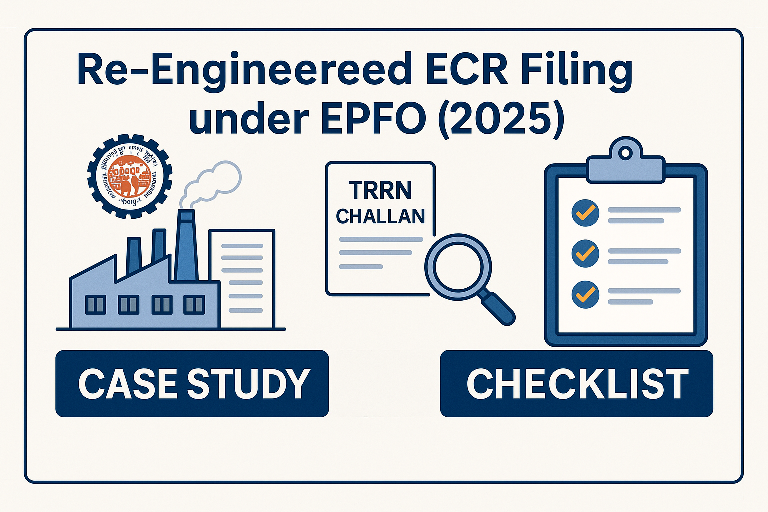
The Employees’ Provident Fund Organisation (EPFO) has redesigned the Electronic Challan-cum-Return (ECR) filing system. The Re-Engineered ECR introduces a stricter, more transparent process that links return filing, challan generation, and payment into a single workflow.
For employers and compliance teams, this reform means fewer loopholes but higher responsibility. Mistakes that were once manageable can now block filings, create bottlenecks, or trigger automatic penalties.
🏛 What is the Re-Engineered ECR?
The system integrates:
🗂 Return Filing – Regular, Supplementary, and Revised Returns.
Once a return is approved, it ❌ cannot be cancelled. Errors must be corrected through a Revised Return. Employers therefore need strong internal checks before approval.
📑 Types of Returns
1️⃣ Regular Return
📅 Filed every wage month for all active members.
📊 Contribution rate: 12% (default) or 10% for notified establishments.
⏳ First 4 months after rollout → partial filing allowed.
🚨 From the 5th month onwards → Regular Return will be accepted only if all active members of earlier months are filed.
2️⃣ Supplementary Return
👥 Used to add new employees missed in the Regular Return.
🔄 Multiple Supplementary Returns allowed for a month.
⚠️ Restriction: a member once added cannot be repeated in another Supplementary Return for that month.
3️⃣ Revised Return
✍️ Used to correct wrong wages, contributions, or member details already filed.
🔄 Once approved, it overwrites earlier filed data.
📉 Downward revisions: allowed only before challan/payment.
📈 Upward revisions: allowed anytime.
🛠 Filing Workflow – Step by Step
🔐 Login to EPFO Employer Portal.
📤 Upload the .txt file in prescribed format.
✅ Approve or ❌ Reject after validation.
📊 On approval → System generates Due Deposit Balance Summary.
💰 Select payment type:
Full Payment
Part Payment (via contribution file)
Admin/Inspection Charges
Interest (7Q) & Damages (14B)
🧾 Generate challan → TRRN assigned.
🏦 Make payment via net banking.
⚠️ Key Compliance Risks
👤 Missed Members → From the 5th month, filings will be blocked if even one earlier active member is not filed.
🚪 Unmarked Exits → If exit dates are not recorded, employees remain active and block new returns.
🛑 No Cancellation → Once approved, returns cannot be withdrawn. Only Revised Return can fix errors.
💸 Automatic Penalties → Section 7Q (interest) and Section 14B (damages) apply for delays or misreporting, with challans auto-generated.
✅ Best Practices for Employers
🚪 Record employee exits promptly in the portal.
👥 Add new joinees immediately via Supplementary Return.
🔍 Verify every return statement carefully before approval.
💾 Save TRRNs, challans, and bank receipts as compliance proof.
📋 Maintain a monthly checklist linking payroll data, active member list, and contribution files.
1) 🏛 What exactly changed in the “Re-Engineered ECR”?
The filing flow is now tightly integrated: upload → validate → approve → summary → challan (TRRN) → bank payment. Once a return is approved, you can’t cancel it. Corrections go through a Revised Return only. You also get stricter checks on member coverage, especially after the 4-month relaxation window.
2) 🔐 Where do I start filing in the employer portal?
Login → Payments → Return Filing (Quick Links) → Return Filing Home Page → Return Monthly Dashboard. Choose wage month, hit Search, then View/Upload to proceed.
3) 🧾 What file format is accepted?
A single .txt file in the exact schema. If the portal sees format or data issues, it generates an error file. Download it, fix the rows it flags, and re-upload.
Pro tip: Always run an internal validation (UAN present, wage values numeric, contribution math correct, correct contribution rate) before upload.
4) 👥 Who must be included in a Regular Return?
All active members for that wage month. During the first 4 months post-rollout, EPFO lets you file a partial Regular Return. From month 5 onward, your Regular Return is accepted only if all earlier active members are already filed. One missed member can block you.
5) 🚪 How should we handle exits so filings don’t get blocked?
Record the Exit Date promptly on the portal. If an exit isn’t marked, that person still counts as “active” and can block future Regular Returns. Make “exit updates” a month-end ritual.
6) 📊 Should I pick 12% or 10% contribution?
Select the legally applicable rate for your establishment (most use 12%; certain notified classes are 10%). Pick it at upload. If you select the wrong rate and approve, you’ll need a Revised Return.
7) ✅ What does “Approve” actually do?
After upload, the system shows a Return Statement. If you Approve, the system locks that dataset and generates a Due Deposit Balance Summary. From there you move into challan generation and payment.
Rule of thumb: If anything looks off, Reject instead of Approve. Fix. Re-upload.
8) ❌ Can I cancel an uploaded return after approval?
No. Once approved, a return cannot be cancelled. If data is wrong, file a Revised Return. If payment is already initiated, downward changes aren’t allowed for that month; upward changes are fine via Revised Return.
9) 🔁 When should I use a Supplementary Return?
Only to add new joinees you missed in the Regular Return. You can file multiple Supplementary Returns for the same month, but each member can be added only once for that month. It isn’t for wage corrections—use Revised Return for that.
10) ✍️ When should I use a Revised Return?
Use it to correct wrong wages, contributions, or member details that were already filed (in Regular or Supplementary). On approval, it overwrites the prior data.
Downward revisions: allowed only before challan/payment for that month.
Upward revisions: allowed anytime.
Also, you can’t file a Revised Return while another return for that month is “in process.”
11) 🧮 What is the “Due Deposit Balance Summary”?
After approval, the portal shows your account-wise dues for that month (what’s payable vs what’s already covered). From here you can choose Full Payment, Part Payment, Admin/Inspection Charges, or 7Q/14B.
12) 💳 What’s the difference between Full Payment and Part Payment?
Full Payment: One shot challan covering all dues for the month.
Part Payment: You upload a contribution file for a portion of dues, approve that file, then generate a challan just for that portion. You can repeat until the balance is zero.
Use Part Payment if you’re regularising phased recoveries or staging cash flows while staying compliant.
13) 🔢 What is TRRN and why is it critical?
TRRN (Temporary Return Reference Number) is the unique ID for each challan. It links your return, the payable amount, and your bank payment. It’s your audit-grade proof. Always archive TRRNs and bank receipts by month and by entity.
14) 🏦 Can I cancel a challan?
In-process challans (generated but not paid) generally show options like Pay or Cancel. If you haven’t paid and something’s off (wrong amount, wrong account mix), cancel and regenerate correctly. Once paid, you can’t cancel—use the returns workflow to correct future dues.
15) ⏳ How do 7Q (interest) and 14B (damages) fit in?
The portal provides a direct challan entry for 7Q (interest) and 14B (damages). If liabilities exist, prepare those challans and pay them alongside or after contribution challans. Treat them as statutory clean-up; they’re not optional.
16) 🧩 We’re stuck in month 5 because earlier members are still missing. What’s the way out?
Two steps only:
Fix status: Mark exits for leavers on the portal; fix UAN/KYC issues.
Supplementary Return: Add the still-active, missed members for those earlier months.
Once approved, the system unlocks your current Regular Return.
No bypass exists—close the gaps or you stay blocked.
17) 🧰 What’s inside the error file and how do we use it well?
The error file highlights row-level problems (format, missing UAN, invalid values, etc.). Correct exactly what it lists; don’t guess. Re-generate your .txt cleanly and re-upload. Build a small internal “common errors” sheet so the same mistakes don’t recur.
18) 🧪 What are the safest pre-approval checks?
UAN present, not deactivated.
Gross wages, EPF wages, and contribution math tally.
Contribution rate matches establishment.
New joinees included (or planned for Supplementary).
Leavers marked Exited in the portal.
No duplicate rows for the same UAN/month.
Download the Return Statement and sanity-scan before hitting Approve.
19) 🧯 We approved the return with wrong wages. What now?
If no payment yet: file a Revised Return with the correct wages.
If payment already made:
For downward corrections, you can’t revise that month’s paid dues. Adjust through permissible future workflows as advised by statute/EPFO office.
For upward corrections, file a Revised Return and pay the difference.
20) 🧑💻 Can we run multiple returns in parallel for the same month?
No. If a return (Regular/Supplementary/Revised) is in process for that wage month, you can’t start another for that month. Finish, approve (or reject), then proceed.
21) 📚 What should we archive for audit defence?
Active Member List (downloaded pre-filing).
Return Statement PDFs.
Due Deposit Balance Summary.
Contribution file approvals (for Part Payment).
TRRNs, challans, and bank receipts.
Any 7Q/14B challans and receipts.
Email trail for late joinee data/exit confirmations from client teams.
22) 🧭 How do we train our team to avoid bottlenecks?
Monthly cut-off checklist: exits marked, joinees verified, payroll vs Active Member List reconciled.
Two-person rule: one prepares .txt, a second reviews Return Statement.
Error library: keep a living doc of common validation failures and fixes.
Tracker: log TRRN, challan date, amount, bank reference—by entity and month.
23) 🧷 Can I add the same employee twice in Supplementary Return?
No. The system won’t allow the same member again for the same wage month. Add once, correctly. If the wages are wrong, that’s a Revised Return job, not Supplementary.
24) 🧭 How should we decide between Immediate Supplementary vs Waiting for Revised?
Missed new joinee → Supplementary immediately.
Wrong data for someone already filed → Revised Return.
Unsure? Ask: “Is this a new person for this month or a data correction?” New = Supplementary; Correction = Revised.
25) 🧩 Any quick, practical example set?
A) New joinee missed
Regular Return already approved; Rahul (joined mid-month) not included.
If unpaid yet → Revised Return with corrected wages → new summary → challan → pay.
If already paid → only upward correction is possible via Revised Return; pay the difference.
C) Month-5 block
Two people show “active” for April because exits not recorded.
Mark exits in portal (correct last working days).
File Supplementary for any truly active missed members.
Proceed to current month Regular Return once approved.
26) 🧱 What are the most common pitfalls—and the fixes?
Pitfall: Approving before reading the Return Statement.
Fix: Always download and check the statement—then approve.
Pitfall: Not marking exits.
Fix: Add “Exit update” to your month-end payroll checklist.
Pitfall: Mixing “new joinee” vs “correction” in the wrong return type.
Fix: New joinee → Supplementary; Correction → Revised.
Pitfall: Losing TRRNs/receipts.
Fix: Centralised tracker + folder structure by entity/month.
27) 🧭 Bottom line—what mindset works best with the new ECR?
Think discipline over rework: close exits on time, capture joinees fast, verify before approval, and treat TRRN like gold. If you do these four things consistently, you’ll avoid blocks, interest, and damages—and your audits will be painless.
The Employees’ Provident Fund Organisation (EPFO) has always been at the centre of India’s social security system. With over 27 crore members contributing through various establishments, efficient record management and transparency in services have been a constant demand.
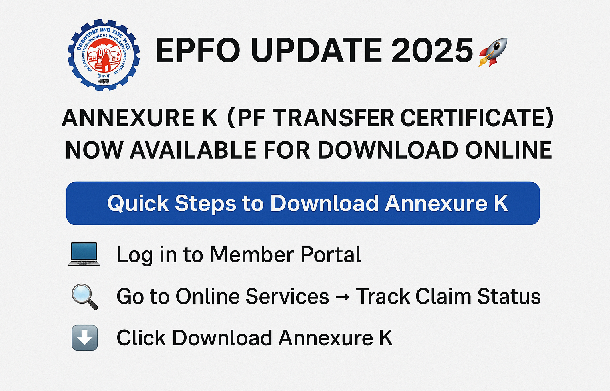
On 18 September 2025, EPFO introduced a major digital update: members can now download Annexure K (PF Transfer Certificate) directly from the EPFO Member Portal 💻. This facility, earlier restricted to inter-office communication, is now openly accessible to members, making PF transfers smoother, faster, and more transparent.
This move supports EPFO’s mission of “ease of compliance, ease of living” for both employers and employees.
📄 What is Annexure K?
Annexure K is a Transfer Certificate issued when a member changes jobs and transfers their Provident Fund (PF) accumulations. It is generated after the processing of Form 13 (Transfer Claim) and is crucial for seamless consolidation of PF accounts.
Contents of Annexure K include:
T C_ Annexure K
💰 PF balance with interest from the previous establishment.
⏳ Complete EPS service history required for pension calculation.
🏢 Employment details of both old and new establishments.
This certificate is prepared by the Transferor Office (source PF office) and sent to the Transferee Office (destination PF office). Now, with this update, the same certificate is downloadable by members themselves.
🔑 Why is Annexure K Important?
Changing jobs often means transferring your PF balance from one account to another. Without proper records, disputes and delays become common. Annexure K acts as the official proof of transfer.
✅ Proof of transfer completion – Ensures your PF balance is credited to your new PF account.
📊 EPS service continuity – Prevents loss of pensionable service, which is critical for retirement benefits.
📢 Grievance resolution – Helps when PF transfer is “approved but not reflecting” in the passbook.
🔍 Employer & auditor checks – Used during audits, reconciliations, and statutory compliance verification.
🛡️ Legal safeguard – Acts as documentary evidence in case of disputes with EPFO or employers.
💻 How to Download Annexure K from EPFO Member Portal
The new facility is available under Online Services on the EPFO Member Portal:
T C_ Annexure K
👉 Step 1: Log in to the EPFO Member Portal using your UAN & password 🌐.
The document will be generated instantly as a PDF.
🌟 Benefits of the New EPFO Facility
⚡ Time efficiency: Members no longer need to visit PF offices.
🔒 Greater transparency: Members can directly verify PF transfer details.
👥 Member empowerment: Shifts control from office-dependent to member-driven.
📢 Faster grievance redressal: Members can attach Annexure K while raising online complaints.
📂 Audit readiness: HR teams can easily reconcile PF transfers during internal or statutory audits.
📊 Practical Scenarios Where Annexure K is Crucial
🔄 Job Switch Verification – After joining a new organisation, verify that your old PF balance is successfully credited.
📝 Pending PF Claim Settlement – Share Annexure K with EPFO if transfer credits are delayed.
⏳ Retirement & Pension Planning – Track and consolidate your total pensionable service under EPS.
📂 Employer Compliance Audits – Employers and consultants can cross-check transfers for statutory filings.
🛡️ Dispute Cases – Strong supporting document in case of mismatch between EPFO records and actual contributions.
🔎 FAQs on Annexure K
Q1. Is Annexure K required for every PF transfer?
👉 Yes, Annexure K is automatically generated once a Form 13 transfer claim is processed.
Q2. Can I download Annexure K for past transfers too?
👉 Yes, the new facility allows members to download Annexure K for both old and new processed claims.
Q3. What if my PF transfer is “approved” but not showing in my passbook?
👉 Download Annexure K and submit it to the destination PF office for reconciliation.
Q4. Does Annexure K affect my EPS (pension) service history?
👉 Absolutely. Annexure K carries your complete EPS service record, which is vital for pension eligibility.
Q5. Where can I raise issues if Annexure K details are wrong?
👉 You can raise a grievance on EPFiGMS (EPFO grievance portal) and attach the Annexure K copy for reference.
🚀 EPFO’s Digital Push – Bigger Picture
This update isn’t standalone. It’s part of EPFO’s larger move towards technology-driven, member-centric services. In recent years, EPFO has introduced:
Online UAN activation & Aadhaar authentication 🔑
Auto-transfer of PF balances upon new employment 🔄
UMANG app integration for PF services 📱
Online pension tracking and e-nomination filing ⏳
Together, these changes highlight EPFO’s commitment to transparency, speed, and digital convenience for millions of employees.
✨ Conclusion
The availability of Annexure K on the EPFO Member Portal is a milestone update. It eliminates dependency on PF offices, speeds up claim settlements, and provides employees with the power to verify their PF transfers independently.
Bottom line: The next time you change jobs or face PF transfer issues, don’t wait. Just log in to your EPFO Member Portal → Online Services → Track Claim Status → Download Annexure K ✅.
This single document can save weeks of delay, protect your pension service history, and give you complete clarity on your PF transfers.
📢 Stay connected with Prakash Consultancy Services (PCS) for regular updates on EPFO, ESIC, PT, LWF, Shops Act, and other labour law compliances.