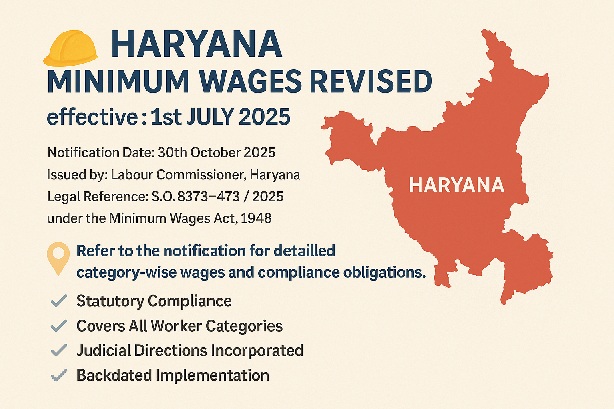
📅 Notification Date: 30th October 2025 🏢 Issued by: Labour Commissioner, Haryana 📜 Legal Reference: S.O. 8373–473 / 2025 under the Minimum Wages Act, 1948
The Government of Haryana has officially revised the minimum rates of wages across all scheduled employments, effective from 01 July 2025. The revision includes updated basic wages and an enhanced Variable Dearness Allowance (VDA) based on the latest Consumer Price Index (CPI).
⚖️ Why This Notification is Important for Employers and Contractors 🔍 Statutory Compliance: As per the Minimum Wages Act, employers must ensure no worker is paid below the notified wages, failing which they may face penalties, prosecutions, and recovery proceedings.
🛠️ Covers All Worker Categories: The notification applies to unskilled, semi-skilled, skilled, and highly skilled workers, including clerical and supervisory staff.
⚖️ Judicial Directions Incorporated: The revised wages also take into account Supreme Court and High Court judgments (e.g., Faridabad Industries Association vs. State of Haryana), ensuring uniform applicability in notified industrial zones like Gurugram, Faridabad, Panipat, etc. 📝 Backdated Implementation: The revised rates are effective from 01.07.2025, meaning all wage calculations, ESIC, PF, and bonus payments must be updated retrospectively.
🧾 Bank Payment Mandate: Wages are to be paid through bank transfer or cheque, with proper maintenance of wage registers and records.
📌 Refer to the official notification dated 30.10.2025 for detailed category-wise wages and compliance obligations. It is essential for HR teams, payroll officers, and contractors to revise internal systems and issue circulars to their vendor workforce immediately.
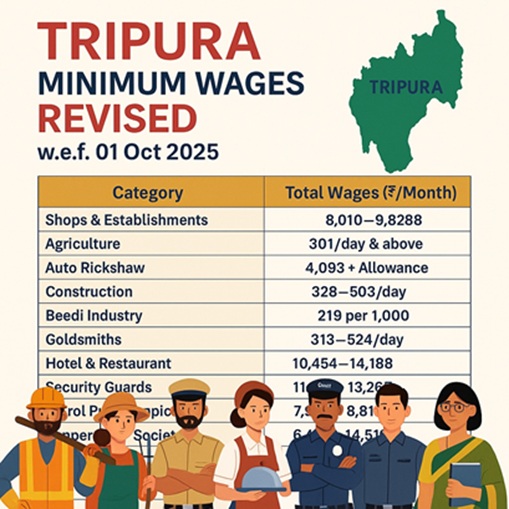
📅 Notification Date: 28 October 2025 🏛️ Issued By: Government of Tripura, Labour Department 📌 Effective From: 01 October 2025 🔍 CPI Increase: 63 Points (Jan–Jun 2025 Period)
📌 Introduction
The Labour Department, Government of Tripura, has revised the Variable Dearness Allowance (VDA) across all scheduled employments under the Minimum Wages Act, 1948. This change is based on a 6-monthly Consumer Price Index (CPI) increase of 63 points from January to June 2025.
This blog provides a detailed sector-wise breakdown of the revised minimum wages for various categories of workers across the state.
VDA is mandatory and must be revised every 6 months
Overtime: Paid at double the ordinary wage rate
Gender Neutrality: Equal pay for equal work for men & women
EPF Contribution: Must be based on revised wages (where applicable)
📤 PCS Compliance Tip:
📋 Ensure your October 2025 payroll reflects the revised VDA-linked wage structure. 🛡️ Failure to implement revised wages can attract penalties under Section 22 of the Minimum Wages Act. 📌 Need help with sector-wise wage sheet updates, notifications, or compliance posters for display at site? 📞 Contact Prakash Consultancy Services (PCS) today!
🔗 Source:
[Tripura Labour Department Gazette Notification – Dated 28 October 2025] (Based on multiple notifications under F.22(…) series)
🔏 EPFO Launches New Browser-Independent DSC Utility for Employers – Effective 10 October 2025
📢 Say goodbye to browser compatibility issues and hello to seamless digital signing!
🗞️ Introduction: A Digital Leap for Compliance with EPFO
The Employees’ Provident Fund Organisation (EPFO) has rolled out a new Digital Signing Service (DSC) exclusively for employers using the Unified Portal. Effective from 10th October 2025, this game-changing utility eliminates browser dependencies and enhances digital security 🔐.
🎯 Targeted Purpose: For now, this DSC utility is primarily designed for:
📝 Approving Joint Declaration Forms (especially for Higher Pension under EPS)
Unified Employer Portal – for digitally signing pension-related forms
🖥️ System & Technical Requirements 📋
🔧 Before you begin, ensure the following are available on your system:
🔧 Hardware & Software
✅ Minimum Requirement
💽 Operating System
Windows 8.1 / 10 / 11 (64-bit only)
🌐 Supported Browsers
Mozilla Firefox, Google Chrome, Microsoft Edge
📦 Port
Port 60015 must be open on your local machine
🔑 DSC Requirement
Valid Class 3/Type 2 DSC token with appropriate certificate authorities
📥 How to Download and Install the EPFO DSC Utility
📌 Available only via EPFO Unified Portal login (Employer Interface)
🛠️ Step-by-Step Installation Guide:
1️⃣ Login to EPFO Unified Portal (Employer) 2️⃣ Navigate to the DSC-required service (e.g., Joint Declaration – Higher Pension) 3️⃣ Download EPFO_DSC_Signer_1.0.0.exe 4️⃣ Run the installer → Click “More Info” → “Run Anyway” 5️⃣ Accept the license agreement and complete the wizard 6️⃣ After setup, double-click DSC Service Icon on the desktop 7️⃣ Ready! The utility will now run in the background to support EPFO signing services 🧩
📍 Note: Install only once, unless a version upgrade is notified.
🌐 Browser Setup Instructions 🔐
After installation, you must import the dscCA2023 certificate into your browser’s Trusted Root Certification Authorities section.
Navigate to DSC Enabled Menu (e.g., Higher Pension Joint Declaration)
Select action: Approve/Reject
Plug in your DSC USB Token 🔌
Choose the signatory name → Click Sign PDF
Enter DSC PIN
✅ Success message will confirm the signing
📂 Verify the document to ensure the correct digital signature is applied
🧯 Common Error: CRL Verification Timeout ⏳
If you face “CRL verification timeout” errors, it’s usually due to:
🧱 CRL URL Blocked by Network Firewall 🌐 Internet not reaching the CRL (Certificate Revocation List) servers 🛠️ Solution:
Identify the CRL URL from your certificate details
Open it via your browser
If unreachable, request your IT/Admin team to whitelist the URL 🔓
🎯 Why This DSC Update Is Important for Employers
🚀 With EPFO’s increasing push towards paperless digital governance, this DSC utility:
💼 Streamlines Pension on Higher Wages processing
📊 Reduces turnaround time for approval workflows
🔐 Enhances data integrity via secure signing standards
🌍 Enables cross-browser compatibility for all employers across India
📣 Final Words: Don’t Delay — Act Before You Miss the Deadline!
The new DSC process is mandatory from 10th October 2025. Start your configuration early to avoid last-minute hassles. Compliance delayed is compliance denied! ⚠️
✅ “Simplify Compliance. Secure the Future.” 🛡️ PCS – Your Compliance Partner for PF, ESIC, LWF & Beyond!
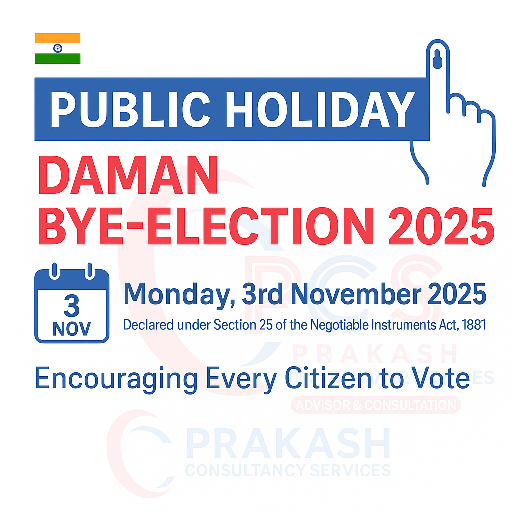
Declared Under Section 25 of the Negotiable Instruments Act, 1881
The Administration of Dadra & Nagar Haveli and Daman & Diu, vide notification from the Collector, Daman District, has declared Monday, 3rd November 2025, as a public holiday on account of the bye-election to the Parliamentary Constituency No. 1 – Daman & Diu.
This order ensures that every eligible voter working in government offices, public sector undertakings, and private establishments in the Union Territory is able to participate in the democratic process without loss of pay or leave benefits
Daman Election Holiday
.
📅 Key Notification Details
Occasion: Bye-Election to Lok Sabha Constituency No. 1 – Daman & Diu
Date of Poll:Monday, 3 November 2025
Holiday Type: Public Holiday (under Section 25 of the Negotiable Instruments Act, 1881)
Applicable Area: Entire Daman District
Issuing Authority: Collector, Daman District
Reference Law: Representation of the People Act 1951 and Negotiable Instruments Act 1881
⚖️ Legal Background
📘 Section 25 of the Negotiable Instruments Act, 1881
The Collector’s declaration makes 3 November 2025 an official public holiday, meaning all banks, financial institutions, government offices, and most private establishments will remain closed in Daman.
📙 Section 135B of the Representation of the People Act, 1951
This section mandates that every person employed in any business, trade, or industrial undertaking shall be granted a paid holiday on polling day so they can cast their vote. Employers cannot impose any deduction or penalty for absence on that day.
🧾 Applicability for Employers and Employees
The notification applies to:
All government departments and offices, including local bodies.
Industrial, commercial, and private establishments situated in Daman.
Contract, daily-rated, and casual employees in both government and private sectors.
If an establishment must continue operations for safety, security, or essential reasons, it must adjust working hours so every voter can exercise their right to vote without loss of wages.
🏢 Employer Action Points
Declare 3 November 2025 as Paid Holiday for all employees eligible to vote.
Display a Notice on the Notice Board quoting this order.
Ensure Contractors and Outsourced Staff are covered and paid accordingly.
Maintain Payroll Evidence – notification copy, attendance sheet marked “Election Holiday”, and communication to contractors.
Avoid Leave Deduction or Wage Loss for any employee availing the holiday.
🗂️ Sample Compliance Entry for Payroll Records
Date
Event
Action Taken
Remarks
03-11-2025
Bye-Election Holiday – Daman
Marked as Paid Holiday (Election Holiday)
Circular displayed and filed under Sec. 25 N.I. Act
🗳️ Civic Importance
The bye-election offers residents of Daman & Diu an opportunity to choose their representative in the Lok Sabha. The administration’s holiday declaration underscores the importance of free and fair participation, ensuring that no employee is deprived of the chance to vote due to work obligations.
📣 Summary at a Glance
Particulars
Details
Region
Daman District, UT of Dadra & Nagar Haveli and Daman & Diu
Election Type
Bye-Election to Lok Sabha Constituency No. 1
Date of Polling
3 November 2025 (Monday)
Type of Holiday
Public Holiday under Section 25 of N.I. Act, 1881
Authority
Collector, Daman District
Purpose
Facilitate voting for all eligible citizens
🏁 Conclusion
All establishments in Daman District must observe Monday, 3 November 2025 as a Public Holiday in accordance with the Collector’s order and the provisions of the Negotiable Instruments Act and Representation of the People Act.
This ensures statutory compliance and promotes active participation in India’s democratic process.
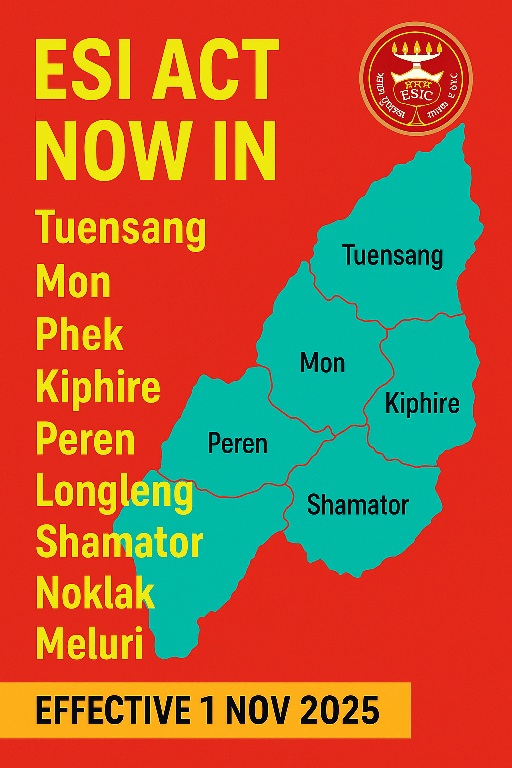
The Ministry of Labour and Employment has officially notified the extension of the Employees’ State Insurance (ESI) Act, 1948 to additional districts of Nagaland, marking another milestone in the nationwide expansion of social-security benefits for workers.
With effect from 1 November 2025, the Act will apply to the entire areas of the following nine districts:
Tuensang, Mon, Phek, Kiphire, Peren, Longleng, Shamator, Noklak and Meluri.
This notification ensures that eligible employees and employers operating in these districts become part of the ESIC social-security network, gaining access to medical, sickness, maternity, disablement, dependants’, and other benefits under the Act.
⚖️ Legal Basis
The Government has invoked the following provisions of the Employees’ State Insurance Act, 1948 (Act No. 34 of 1948):
Sections 38 to 43 – Compulsory insurance and contribution obligations.
Sections 45A to 45H – Assessment of contributions, inspection, and penalties for non-compliance.
Section 76 (2) to (4) – Constitution and powers of ESI Courts.
Sections 82 and 83 – Bar of jurisdiction and protection to officers for acts done in good faith.
These sections collectively operationalise the core functioning of the ESI scheme—mandatory registration, contributions, benefits, and dispute-resolution mechanisms.
🌍 Districts Covered Under the Notification
Sr No
District Name
Applicability Area
Effective Date
1
Tuensang
Entire District
1 Nov 2025
2
Mon
Entire District
1 Nov 2025
3
Phek
Entire District
1 Nov 2025
4
Kiphire
Entire District
1 Nov 2025
5
Peren
Entire District
1 Nov 2025
6
Longleng
Entire District
1 Nov 2025
7
Shamator
Entire District
1 Nov 2025
8
Noklak
Entire District
1 Nov 2025
9
Meluri
Entire District
1 Nov 2025
🧾 Key Provisions for Employers
From 1 November 2025, every establishment situated in these districts must –
Register the Establishment
Apply online via the ESIC portal and obtain an ESI Code Number.
Register all eligible employees (earning up to the prescribed wage limit).
Commence Monthly Contributions
Deduct 0.75 % (employee share) and pay 3.25 % (employer share) of gross wages.
File ECR (Electronic Challan-cum-Return) and make payment before the due date.
Display Statutory Notices
Exhibit ESIC information at the workplace in English and the local language.
Maintain Registers and Records
Keep employee attendance, wage, and contribution records available for inspection.
Ensure Contract Labour Coverage
Principal employers must verify that contractors register and deposit ESI contributions for their workers.
Update Payroll and Compliance Calendars
Incorporate ESI parameters from the wage period commencing on or after 1 November 2025.
💠 Benefits to Employees and Insured Persons
The extension of the ESI Act guarantees access to the following benefits:
Benefit Type
Description
Medical Benefit
Full medical care for insured persons and dependants through ESIC dispensaries and hospitals.
Sickness Benefit
Cash compensation during certified illness (70 % of wages for up to 91 days).
Maternity Benefit
For female insured persons during confinement or miscarriage.
Disablement Benefit
Financial assistance for temporary or permanent disablement due to employment injury.
Dependants’ Benefit
Monthly pension to dependants of a deceased insured person.
Funeral Benefit
Lump-sum funeral expenses to the family of a deceased insured person.
🧮 Compliance Timeline
Activity
Due Date
Registration of Establishment
Before 1 Nov 2025
Employee Registration
Before first ESI-liable wage payment
ECR Filing and Payment
By 15th of the following month
Display of Notices
Within 30 days of applicability
Half-yearly Return (if applicable)
Within 42 days after contribution period
🏢 Who Is Covered?
All factories and establishments employing 10 or more persons in the notified districts.
Certain categories may also be covered as shops, restaurants, hotels, cinemas, road-transport, educational or medical institutions, as per previous ESIC notifications in the State.
Wage ceiling for coverage remains ₹21,000 per month (₹25,000 for employees with disabilities).
❓ Frequently Asked Questions
Q1. From which date will ESI deduction start in Nagaland districts? 👉 From the first wage period commencing on or after 1 November 2025.
Q2. Does this apply to contract employees too? ✅ Yes. Principal employers must ensure coverage for contract and outsourced workers.
Q3. What if the establishment fails to register in time? ⚠️ Non-registration or non-payment may lead to interest, damages, and penal prosecution under Sections 85 and 85A of the ESI Act.
Q4. Can existing employees be registered after 1 Nov 2025? Yes—but contributions and benefits will be counted prospectively. Timely registration is advised to avoid liability.
📈 Impact on Nagaland’s Workforce
This expansion of the ESI network is a progressive step towards universal social-security coverage for workers in India’s North-East region. Employers gain structured medical support for their staff, while employees and families receive comprehensive health protection at nominal contribution rates.
🏁 Conclusion
The notification effective from 1 November 2025 brings nine districts of Nagaland under the ESI umbrella, ensuring that more workers enjoy medical and social security benefits. Employers should immediately initiate registration and update their HR systems to align with the new requirements.
🪪 Reference
Notification: Employees’ State Insurance (ESI) Act, 1948 – Implementation in Nine Districts of Nagaland
Issuing Authority: Ministry of Labour & Employment, Government of India
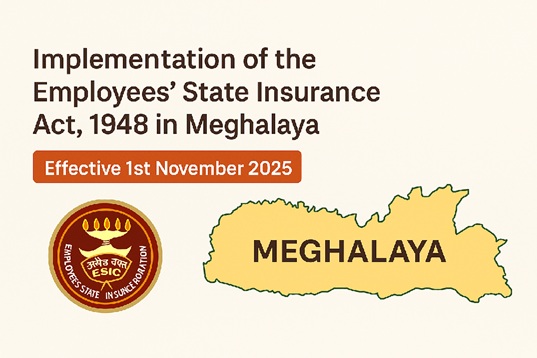
The Ministry of Labour and Employment, Government of India, through its latest Gazette Notification dated 17th October 2025, has extended the provisions of the Employees’ State Insurance Act, 1948 (ESI Act) to several districts of Meghalaya, marking a major step in expanding the reach of social security benefits in the North-Eastern region.
📅 Effective Date of Implementation
The Central Government has appointed 1st November 2025 as the date from which specific provisions of the ESI Act shall come into force in the following districts of Meghalaya:
West Garo Hills
South Garo Hills
North Garo Hills
East Garo Hills
South West Garo Hills
West Jaintia Hills
This expansion brings all industrial, commercial, and eligible establishments within these districts under the ESI coverage.
⚖️ Provisions Enforced
From 1st November 2025, the following provisions of the Employees’ State Insurance Act, 1948 shall be applicable in the notified areas:
Section Numbers
Description
Sections 38 to 43
Compulsory insurance for employees and contribution by employer & employee
Sections 45A to 45H
Determination and recovery of contributions
Sections 46 to 75
Benefits payable to insured persons and their dependants (sickness, maternity, disablement, etc.)
Section 76 (2)–(4)
Constitution and jurisdiction of Employees’ Insurance Courts
Sections 82 & 83
Powers to make rules and remove difficulties
🏢 Applicability & Coverage
1️⃣ Establishment Coverage
All factories and establishments (industrial or commercial) employing 10 or more persons using power, or 20 or more persons without power, as per ESI Act definitions.
The Act applies irrespective of wages to determine coverage; however, employee contributions are applicable only for employees earning wages up to ₹21,000 per month (₹25,000 for employees with disabilities).
2️⃣ Employee Eligibility
Every employee whose wages (excluding overtime) do not exceed the prescribed ceiling will be covered.
Employers must ensure proper registration of all such eligible employees on the ESIC portal.
💼 Employer’s Action Points
Employers operating in the above-mentioned districts must take the following actions to ensure timely compliance from November 2025:
Step
Action
Deadline / Remarks
1
Register establishment on the ESIC Portal (if not already registered)
Before 1st November 2025
2
Obtain ESI Employer Code from the Regional Office
One-time registration
3
Register all eligible employees with valid Aadhaar and bank details
Before first wage cycle in November 2025
4
Start deducting employee contribution @0.75% and pay employer contribution @3.25% of wages
From wage month of November 2025
5
File Monthly Contribution (MC) Return
By 15th December 2025 (for Nov-2025)
6
Display ESI Notice (Form-1) at the establishment
Mandatory display under the Act
7
Maintain prescribed registers, attendance, and wage records
For inspection and audit purposes
🧾 Benefits to Insured Employees
Once registered under the ESI scheme, insured persons and their dependants become entitled to a wide range of medical and cash benefits, including:
Benefit Type
Description
Medical Benefit
Full medical care to insured employees and their dependants from ESI dispensaries/hospitals
Sickness Benefit
Cash compensation at 70% of wages for certified sickness
Maternity Benefit
Paid leave for confinement, miscarriage, or sickness arising out of pregnancy
Disablement Benefit
Monthly pension for temporary or permanent disablement due to employment injury
Dependants’ Benefit
Monthly pension to dependants in case of death due to employment injury
Funeral Expenses
₹15,000 (or as revised) towards funeral cost of the deceased insured person
🏛️ Administrative Jurisdiction
The implementation will fall under the administrative supervision of the ESIC Regional Office, Guwahati, and its Local Office network. Employers in Meghalaya may coordinate with their nearest ESIC Office for code allotment, branch office linkage, and dispensary mapping.
📢 Key Compliance Reminder
✅ The first ESI Contribution for the notified Meghalaya districts shall become due for the wage month of November 2025, and must be deposited by 15th December 2025 along with the Monthly Contribution filing on the ESIC portal.
Failure to comply may attract penalties under Section 85 of the ESI Act, including fines and prosecution.
🌐 Summary Table
Parameter
Details
Act
Employees’ State Insurance Act, 1948
Notification Date
17th October 2025
Effective Date
1st November 2025
Applicable Areas
Six districts – West/North/East/South/South-West Garo Hills and West Jaintia Hills
Employer Contribution
3.25% of wages
Employee Contribution
0.75% of wages
First Return Due Date
15th December 2025
Wage Ceiling for Coverage
₹21,000 (₹25,000 for PwDs)
🧭 PCS Compliance Insight
With this extension, the ESI Act coverage now expands deeper into the North-Eastern region, ensuring social security for a larger workforce. Employers in the newly notified areas should immediately begin groundwork for registration, record preparation, and employee onboarding to avoid last-minute non-compliance.
PCS recommends initiating a pre-implementation compliance audit in October 2025 to verify readiness for ESIC deductions, portal setup, and wage register updates.
✍️ Disclaimer
This article is intended for informational purposes only. Employers are advised to refer to the official Gazette notification dated 17th October 2025 and consult with compliance professionals for case-specific applicability.
📅 Date: 13th October 2025 📍 Venue: New Delhi 👤 Chaired by: Dr. Mansukh Mandaviya, Hon’ble Union Minister for Labour & Employment and Youth Affairs & Sports 🗂️ Event: 238th Meeting of the Central Board of Trustees (CBT), Employees’ Provident Fund Organisation (EPFO)
🔹 Overview
The Central Board of Trustees (CBT) of the Employees’ Provident Fund Organisation (EPFO) held its 238th meeting on 13th October 2025, chaired by Dr. Mansukh Mandaviya, Union Minister for Labour & Employment and Youth Affairs & Sports.
Also present were Vice-Chairman Sushri Shobha Karandlaje, Co-Vice-Chairperson Ms. Vandana Gurnani, Mr. Ramesh Krishnamurthi (Secretary, Labour & Employment), and the Central Provident Fund Commissioner.
During the meeting, the Board approved several transformative policy changes, reflecting EPFO’s ongoing commitment to ease of living for members, ease of compliance for employers, and transparent governance.
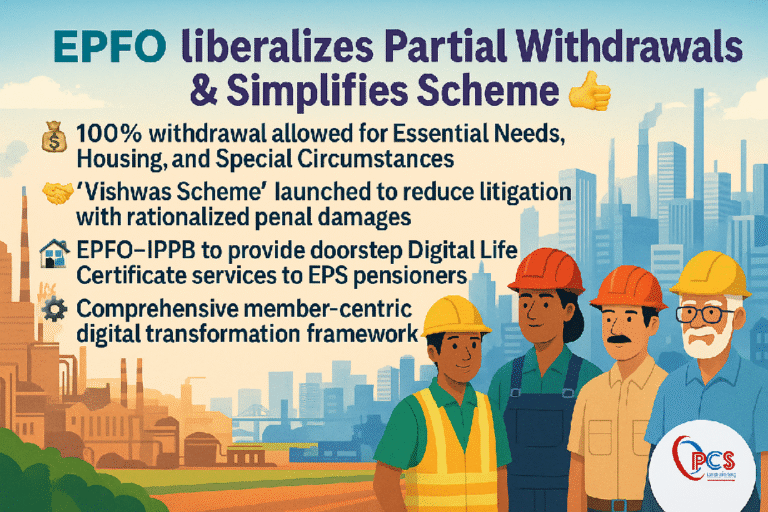
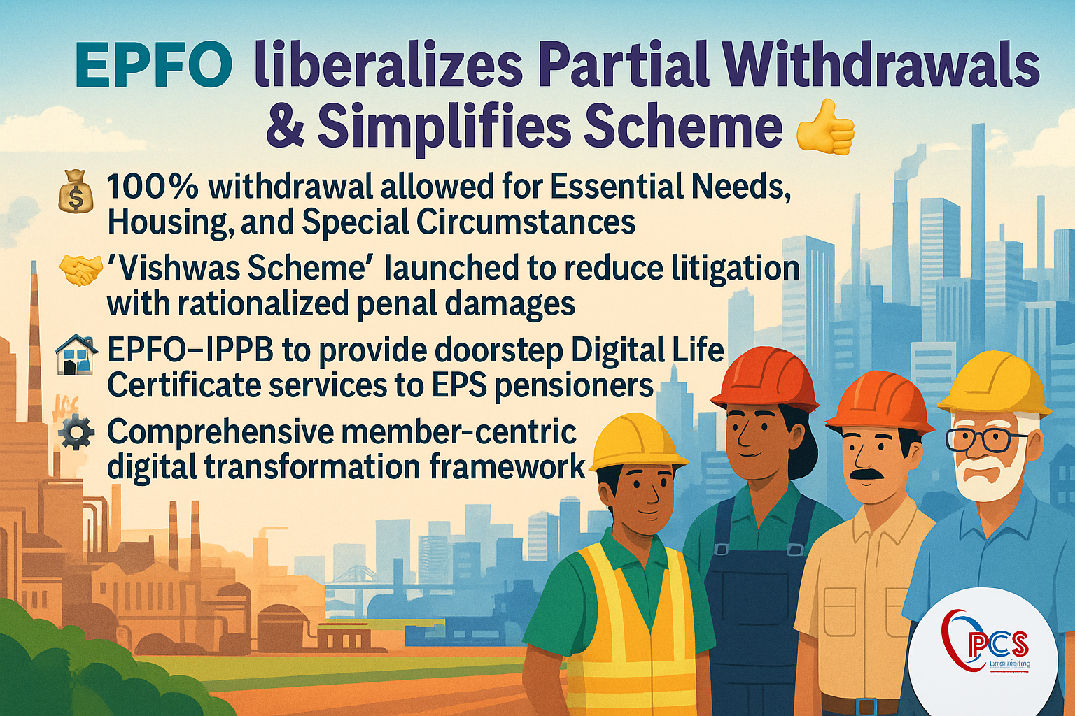
🔹 1. Liberalised & Simplified Partial Withdrawals
The Board approved simplified and liberalised provisions for EPF withdrawals, combining 13 complex rules into one streamlined framework.
✅ Key Highlights
Category
Coverage
New Rule / Limit
Earlier Rule
Essential Needs
Illness, Education, Marriage
– Education withdrawals allowed up to 10× of monthly wages. – Marriage withdrawals up to 5× (earlier combined limit of 3).
Multiple sub-clauses; separate service periods & documents.
Housing Needs
Purchase, construction, or repayment of home loan
Members can withdraw up to 100% of eligible balance (employee + employer share).
Capped at 90% with several forms and declarations.
Special Circumstances
Calamities, unemployment, epidemic, closure of establishment
Members can apply without specifying reasons.
Required declaration with detailed justification.
🔍 Service Condition & Auto-Settlement
Service Requirement: Uniformly reduced to 12 months.
Minimum Balance: 25% of corpus must remain for continuous interest accumulation (8.25% p.a.).
Automation: 100% system-based auto-settlement of partial claims to ensure instant disbursal.
📊 Impact: These changes remove administrative bottlenecks, reduce rejection rates, and simplify access for over 7 crore active members.
🔹 2. Revised Timeline for Final Withdrawals
Type of Settlement
Earlier Period
Revised Period
Premature Final EPF Settlement
2 months
12 months
Final Pension Withdrawal (EPS-95)
2 months
36 months
This ensures members maintain their accounts for a longer period, optimising retirement corpus accumulation while enabling access in genuine need-based situations.
🔹 3. Vishwas Scheme – Rationalised Penal Damages
To reduce litigation and encourage voluntary compliance, EPFO has launched the Vishwas Scheme, rationalising the penal damages under Section 14B of the EPF & MP Act, 1952.
⚖️ Context
As of May 2025, EPFO reported:
Outstanding penal damages: ₹2,406 crore
Over 6,000 litigation cases pending in High Courts, CGITs, and the Supreme Court
Around 21,000 potential cases under e-proceedings portal
Historically, damage rates ranged from 5%–25% per annum (and up to 37% before 2008). These punitive rates led to massive litigation.
🧾 Key Provisions of Vishwas Scheme
Default Duration
Revised Damages
Earlier Rate
≤ 2 months
0.25% per month
Flat 1%
≤ 4 months
0.50% per month
Flat 1%
> 4 months
1.00% per month
Flat 1%
🔸 Applicability
The scheme covers:
Pending litigation under Section 14B (CGIT, High Courts, Supreme Court)
Finalised but unpaid 14B orders
Pre-adjudication notices awaiting final order
📆 Validity
Operative for 6 months, extendable by another 6.
Compliance under the scheme will abate all pending cases automatically.
💬 Benefit:
Predictable penalty regime.
Reduced legal expenditure and disputes.
Faster recovery of dues and improved trust in EPFO’s processes.
🔹 4. Doorstep Digital Life Certificate (DLC) for Pensioners
EPFO has approved a MoU with India Post Payments Bank (IPPB) to provide doorstep Digital Life Certificate (DLC) services for EPS-95 pensioners.
Feature
Description
Cost
₹50 per certificate – fully borne by EPFO
Beneficiaries
All EPS-95 pensioners (urban and rural)
Delivery Mode
Through IPPB’s postmen and Gramin Dak Sevaks
Integration
With Centralised Pension Payment System (CPPS)
🎯 Impact: Pensioners, especially in remote locations, can now verify life certificates from home — ensuring uninterrupted pension continuity and improved convenience.
🔹 5. EPFO 3.0 – Comprehensive Digital Transformation
EPFO has adopted a Core Banking + Cloud Native + API-First architecture called EPFO 3.0, focusing on automation, transparency, and real-time service delivery.
Enables creation of new offices via system (not possible since 2017).
Strengthens district-level service coverage.
Upgraded e-Office (v7)
Enhanced document management and file tracking.
Faster approvals and reduced backlog.
SPARROW for APAR
Online appraisal system for officers/staff.
Promotes transparency and efficiency.
💡 Benefits of EPFO 3.0
Instant claim processing
24×7 availability
Multilingual user interface
Seamless payroll-linked contributions
Improved data integrity & faster grievance redressal
🔹 6. Financial Governance – Appointment of Fund Managers
The CBT approved appointment of four Fund Managers to handle EPFO’s debt portfolio for 5 years.
This follows recommendations from the Selection Committee and Investment Committee, comprising CBT members, senior officials, and an external investment expert.
🎯 Goal: Strengthen portfolio diversification, prudent asset management, and maximise member returns on EPF savings.
🔹 7. Additional Announcements
🔸 PM-Viksit Bharat Rozgar Yojana (PM-VBRY)
Announced by Hon’ble Prime Minister on 15th August 2025.
Outlay of ₹99,446 crore; aims to create 3.5 crore jobs (Aug 2025–Jul 2027).
August 2025 performance:
79,098 establishments under Part B (employer side)
6 lakh first-time employees under Part A
16.78 lakh UANs created using Face Authentication Technology (FAT).
🔸 Global Recognition
India honoured with ISSA Award 2025 at the World Social Security Forum, Malaysia, for expanding social security coverage from 19% (2015) to 64.3% (2025). India also gains a seat on the ISSA Bureau, enabling leadership in international social-security collaboration.
🔸 India–UK DCC Agreement
Allows Indian employees on short-term deputation to continue contributing to their home-country PF accounts for up to 36 months – avoiding double contributions.
🔸 Operational Efficiency
Interest @ 8.25% credited to all members by July 2025 — the earliest ever.
Launch of Passbook Lite and Online Annexure-K for seamless account transfer visibility.
Establishment of new zonal and regional offices to bring EPFO services closer to workers nationwide.
🧾 8. Summary of Key Highlights
Focus Area
Key Decision
Impact
Member Convenience
Simplified 100% EPF withdrawals
Faster, paperless claim settlement
Employer Relief
Vishwas Scheme for penal damages
Litigation-free compliance environment
Pensioner Support
Doorstep DLC via IPPB
Ease of living for EPS-95 pensioners
Technology Reform
EPFO 3.0 Digital Framework
Automation, real-time processing
Governance & Finance
Appointment of fund managers
Prudent investment and transparency
Social Security Expansion
PM-VBRY & ISSA recognition
3.5 crore jobs + global leadership
🧭 9. Conclusion
The 238th CBT meeting marks a transformational milestone for the EPFO. From liberalised withdrawals to graded penalties, and from digital automation to doorstep pensioner services — every reform moves India’s social-security framework towards efficiency, equity, and empowerment.
💬 Dr. Mansukh Mandaviya stated:
“EPFO’s reforms reflect the Government’s commitment to ensure ease of living for members, ease of compliance for employers, and transparent governance for all.”
The Government of Jharkhand, through the Labour, Employment, Training and Skill Development Department, has issued an official notification revising the minimum wage rates payable to contract workers under the Contract Labour (Regulation & Abolition) Rules, 1972.
This revision will take effect from 1st April 2025, in accordance with the provisions of Section 13(iii) of the Minimum Wages Act, 1948, which empowers the State Government to revise minimum wage rates periodically based on changes in the cost of living index.
🏛️ Reference Details
Notification No.: श्रम/प्रशा-1127
Date of Issue: 28.06.2024
Effective From: 01.04.2025
Issuing Authority: Labour, Employment, Training and Skill Development Department, Government of Jharkhand
Subject: Revision of minimum wages for contract workers due to increase in consumer price index (महँगाई भत्ता)
📊 Revised Minimum Wages for Contract Workers (Effective 01.04.2025)
Category of Worker
Existing Basic Wages (as on 28.06.2024)
Revised DA / CPI Increase (as on 01.04.2025)
Total Revised Wages (₹ / Month)
Unskilled (अकुशल)
₹12,203.36
₹854.23
₹13,057.59
Semi-Skilled (अर्ध-कुशल)
₹12,784.72
₹894.93
₹13,679.65
Skilled (कुशल)
₹16,853.20
₹1,179.72
₹18,032.92
Highly Skilled (अति-कुशल)
₹19,467.76
₹1,362.74
₹20,830.50
🧾 Key Highlights
✅ The revised rates are applicable to all establishments engaging contract labour in the State of Jharkhand. ✅ The revision reflects the increase in the cost of living (महँगाई भत्ता) from the last notified period dated 28.06.2024. ✅ The order applies uniformly across all districts and industrial sectors where the Contract Labour (Regulation & Abolition) Act, 1970 is applicable. ✅ The updated wage rates ensure parity with inflation and promote fair compensation for workers engaged under contractors.
⚖️ Legal Basis
This revision has been made under:
Rule 25(2)(v)(b) of the Contract Labour (Regulation & Abolition) Rules, 1972, and
Section 13(iii) of the Minimum Wages Act, 1948, which empowers the Government to enhance wages linked to the Consumer Price Index (CPI).
The notification thus ensures that wages of contract workers keep pace with inflation and uphold the principle of “equal pay for equal work.”
🏢 Impact on Employers
Employers and contractors operating within Jharkhand must:
Revise wage structures for all categories of contract workers effective 01.04.2025.
Update wage registers (Form XVII) and display updated wage rates on notice boards at work premises.
Ensure that no worker is paid below the prescribed minimum wage, failing which action may be taken under the Minimum Wages Act, 1948.
📆 Implementation Timeline
Action
Deadline / Effective Date
Responsibility
Notification Issue
28 June 2024
Government of Jharkhand
Effective Date of New Rates
01 April 2025
All Employers & Contractors
Wage Revision Implementation
From April 2025 Salary Cycle
HR / Payroll Departments
💬 Conclusion
The Jharkhand Minimum Wage Revision (April 2025) demonstrates the State’s proactive stance in safeguarding the welfare of its workforce. Employers are advised to comply strictly with the revised rates to avoid any penalties and ensure alignment with statutory labour laws.
This update ensures that workers across Jharkhand receive fair, inflation-adjusted compensation, strengthening both compliance and employee welfare in the state.
📅 Notification: G.S.R. 749(E) dated 10th October 2025
📜 Issued By: Ministry of Labour & Employment, Government of India
👷♂️ Effective Period: From 1st November 2025 to 30th April 2026
⚖️ Reference: Employees’ Provident Funds & Miscellaneous Provisions Act, 1952
🌟 Introduction
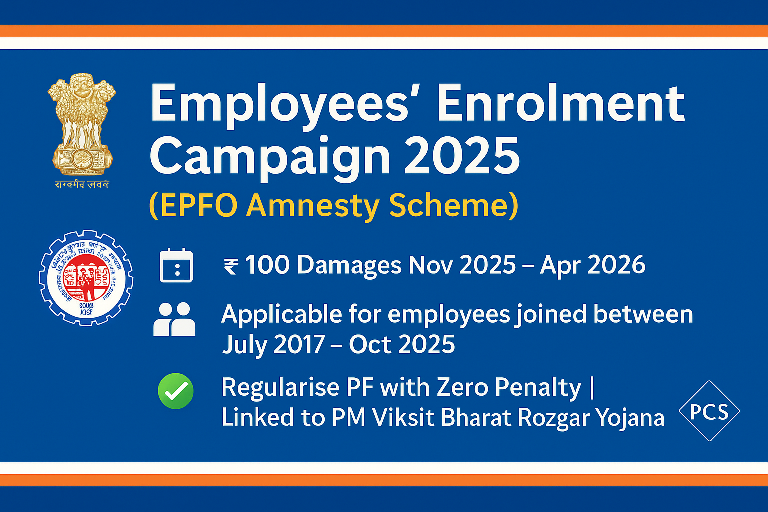
The Ministry of Labour & Employment has introduced a special amnesty window titled “Employees’ Enrolment Campaign, 2025 (EEC 2025)” under the Employees’ Provident Funds Scheme, 1952.
This scheme provides employers — whether covered or uncovered under EPFO — a one-time opportunity to voluntarily enrol un-enrolled employees and regularise pending PF compliance for the period 1st July 2017 to 31st October 2025, with nominal damages of ₹100 and a waiver of the employee’s share of contribution.
📘 Legal Reference
The campaign is notified through G.S.R. 749(E) dated 10 October 2025, by inserting Paragraph 82B in the EPF Scheme, 1952.
It is issued under the powers conferred by Section 5 read with Section 7(1) of the EPF & MP Act, 1952.
🔹 Key Highlights of Employees’ Enrolment Campaign 2025
Particulars
Details
Scheme Name
Employees’ Enrolment Campaign, 2025 (EEC 2025)
Effective Dates
1 November 2025 to 30 April 2026
Coverage Period
1 July 2017 to 31 October 2025
Eligible Employers
All establishments, covered or not covered under EPFO
Eligible Employees
Employees who joined between 1 July 2017 – 31 October 2025, are alive and employed on the date of declaration
Employers must ensure Face Authentication UAN creation for each eligible employee through the UMANG Application before declaration.
2️⃣ Generate and File ECR
Prepare an Electronic Challan-cum-Return (ECR) for the declared employees, covering:
Employer’s share contribution
Interest under Section 7Q
Applicable administrative charges
₹100 damages (one-time only)
3️⃣ Make Online Declaration
Submit the declaration under Employees’ Enrolment Campaign, 2025 via the EPFO portal, linking it with the relevant TRRN/ECR.
4️⃣ Continue Regular Compliance
From the month of declaration, the employer must continue regular monthly compliance under EPF, EPS, and EDLI schemes.
💸 Financial Benefits Under the Scheme
Component
Payable by Employer
Remarks
Employer Share
✅ Yes
For entire past period from date of joining
Employee Share
❌ Waived
If not deducted earlier
Interest (u/s 7Q)
✅ Yes
On employer’s share only
Admin Charges
✅ Yes
As applicable
Damages
💰 ₹100 only
One-time lump sum for all three schemes
⚙️ Damages Table – New Table-2 under Para 32-A
Period of Default
Rate of Damages
1 July 2017 – 31 October 2025
₹100 (one-time, lump sum)
⚠️ Important Conditions
Multiple declarations are not allowed.
All eligible employees must be declared in a single submission.
Declarations made with false information or suppression of facts will be void ab initio and attract penal action.
Cases concluded under Section 7A / Para 26B / Para 8 before the scheme date will not be reopened.
No suo-motu action by EPFO against employers who submit declaration and undertaking confirming no dues.
Period before 1 July 2017 is not covered under this campaign.
🤝 Linkage with Pradhan Mantri-Viksit Bharat Rojgar Yojana (PMVBRY)
✅ Eligibility for PMVBRY Benefits
Employers who register under EEC 2025 or declare additional employees will also be eligible for PMVBRY benefits, subject to scheme conditions.
Part
Benefit Description
Part A
Applies to new employees joining after declaration or inquiry conclusion.
Part B
Applies after six months from declaration or inquiry conclusion — valid up to 31 July 2027. Additional employees declared under EEC 2025 will be added to the employer’s baseline count.
Adjustment Clause
If PMVBRY benefits already availed, future dues will be adjusted or recovered accordingly.
🧩 Impact for Employers
✅ Advantages
Legal regularisation of past PF omissions since 2017.
Waiver of employee share if not deducted.
Fixed ₹100 damage — huge saving compared to normal rates.
No penalty or prosecution if declared truthfully.
Eligibility to claim PMVBRY incentives for new hires.
⚠️ Precautions
Ensure correct employment data before declaration.
Generate valid UANs through Face Authentication (UMANG).
Maintain proof of wages, attendance, and employment continuity.
📅 Validity Period
Commences: 1 November 2025 Ends: 30 April 2026
Employers should utilise this six-month golden opportunity to cleanse old PF records and align with EPFO compliance before routine inspections resume.
The Employees’ State Insurance Corporation (ESIC) has released the updated list of Super Speciality Treatment (SST) tie-up hospitals in Maharashtra through its Regional Office Mumbai, effective 01 September 2025.
This ESIC SST tie-up list for Maharashtra ensures that insured employees and their dependents can avail cashless treatment facilities in empanelled super speciality hospitals across the state, including Mumbai, Pune, Nagpur, Nashik, Aurangabad, and other cities.
🏥 Coverage: ESIC empanelled hospitals for super speciality treatment (SST)
💳 Facility: Cashless treatment for ESIC insured employees and dependents
📍 Cities Covered: Mumbai, Pune, Nagpur, Nashik, Aurangabad, and others
📌 Why the Updated ESIC Hospital List is Important
The updated ESIC SST hospitals list in Maharashtra 2025 provides employees with access to quality medical care. This list is critical for:
✅ Employees & Dependents – Easy access to ESIC empanelled hospitals for cardiology, nephrology, oncology, neurosurgery, gastroenterology and other super specialities.
✅ Employers & HR Managers – Ensures correct information is shared with employees to avoid treatment delays.
✅ Compliance Officers – Helps meet ESIC statutory obligations under the ESI Act, 1948.
🏥 ESIC Tie-Up Hospitals in Maharashtra (Representative List – Sept 2025)
📍 City / Region
🏥 ESIC Empanelled Hospital
🌐 Super Speciality Services
💳 Facility
Mumbai
ESIC Tie-Up Hospital, Andheri
Cardiology, Orthopaedics
Cashless
Pune
Super Speciality Hospital, Shivajinagar
Oncology, Nephrology
Cashless
Nagpur
ESIC SST Medical Institute
Neurosurgery, Urology
Cashless
Nashik
ESIC Hospital, Panchavati
Gastroenterology, Nephrology
Cashless
Aurangabad
ESIC Empanelled City Hospital
Multi-Speciality
Cashless
👉 Note: This is an indicative table. For the complete official list of ESIC SST tie-up hospitals in Maharashtra (as on 01.09.2025), refer to the official notification issued by RO Mumbai.
👷 Guidance for Employees & Employers
Employees should carry their ESIC Pehchan Card / e-Pehchan Card while availing treatment.
Employers must circulate the updated ESIC SST hospital list Maharashtra 2025 among employees.
HR/Admin should display the list on company notice boards for worker awareness.
For emergency admissions, contact the ESIC Regional Office Mumbai helpdesk or the ESIC desk at the hospital.
⚖️ Compliance Note
Providing access to ESIC super speciality treatment hospitals is a statutory requirement under the ESI Act, 1948. Employers who fail to inform employees about ESIC tie-up hospitals may face compliance gaps during inspections.
📍 Conclusion
The updated ESIC tie-up hospital list in Maharashtra (effective September 2025) ensures insured employees and their families have access to cashless super speciality healthcare across the state.
This update strengthens ESIC’s role in providing affordable healthcare and compliance-driven benefits to the workforce.
👉 Employers, HR managers, and compliance officers must ensure they download and circulate the official ESIC Maharashtra hospital list 2025 (RO Mumbai update) to employees without delay.